Men’s Group: The Room Where It's Finally the Right Time
I wrote this because I wish someone had handed it to me twenty years ago.
Not as a pitch to a program but as a reminder that the weight most men are carrying was never meant to be carried alone, and that the kind of community where you can actually set it down is rarer than it should be but more available than most men realize.
If you are reading this before your first group, I am glad you are here. If you are reading it because someone sent it to you and you are not sure it is for you, keep going. If you are reading it because you are already part of this and want to share it with someone in your life who might need it, thank you for thinking of them.
Whatever brought you here, I hope this finds you at the right time.
Mike
There is a version of this man you probably recognize. He is somewhere in his late thirties, maybe early forties. He runs a business or manages a team, shows up early, and handles things. His family and employees depend on him. He works out most mornings because that is the one hour of the day that belongs entirely to him, and because the physical effort is the closest thing he has to a release valve. He is functioning, “fine” and at considerable cost, and the cost is mostly invisible because he has never said it out loud to another person.
Call him Mark.
Mark has been carrying something for about two years. Not a crisis, nothing dramatic, more like a low-grade pressure that never fully lifts. A marriage that has become more logistical than intimate. A career that looks successful from the outside, but has stopped asking much of him a long time ago. A father who is aging and a conversation they have never had and probably never will. He knows all of this, has thought about it more than he would admit, and has arrived at the same place every time: there is no good moment to bring any of it up, no context in which it feels appropriate, no relationship in his life where the full weight of it would be welcome. So he carries it, the way capable men learn to carry things, quietly and for a long time.
He comes to the men's group because a friend mentioned it twice, and he finally ran out of reasons to say no.
He sits in the circle listening to the man across from him say something honest in a way that Mark has not heard a man say in years. And somewhere in the middle of that, something in Mark's chest shifts, a quiet recognition that he has been waiting for a room like this without knowing that was what he was waiting for.
Julianne Holt-Lunstad, a psychologist at Brigham Young University, has spent two decades studying what social isolation actually does to the human body. Her findings are not subtle. A 2015 meta-analysis drawing on data from more than three million people concluded that inadequate social connection increases the risk of early death by twenty-six percent, a mortality risk comparable to smoking fifteen cigarettes a day. This is not a finding about feelings. It is a finding about biology, about what happens to a body that is chronically without the connection it was designed to require.
The problem is not that men do not want connection. The problem is that the structures which used to produce it have largely disappeared. Robert Putnam documented the decades-long collapse of the civic and associational life that once held men together, the bowling leagues, the fraternal organizations, the neighborhood infrastructure that created repeated, low-stakes contact between men outside of work and family. What replaced them was the private life, the nuclear household, the phone. The result is a generation of capable, successful, quietly isolated men who have not had a real conversation with another man in longer than they can remember, not because they chose isolation but because nothing in their daily life makes connection easy or expected anymore.
Sebastian Junger spent years embedded with combat units in Afghanistan and came back asking a question that most people were not asking: why did so many of the men he knew struggle more after coming home than they had during the war itself? His answer, developed in his book Tribe, was that they had left behind something the civilian world could not offer, the radical intimacy of men who know each other fully, depend on each other completely, and are known in return. That level of connection is not available in ordinary modern life, Junger argues, and the absence of it produces a specific kind of suffering that no amount of individual achievement can address, because it was never an individual problem to begin with.
I want to be direct about why I started hosting these groups.
I have lost people to suicide. Family members, friends. Men I cared about who were, by every external measure, doing fine. And the thing that has stayed with me, the thing I have never been able to fully put down, is that I did not know. I did not know they were struggling at that level. And I have asked myself many times whether there was ever a moment when they almost said something and decided the timing was wrong, or that it was too much, or that no one really wanted to hear it.
I do not know the answer to that. But I know that one of the things I believe more than ever now is that men need spaces where it is always the right time. Where you do not have to wait for the right moment or the right relationship or the right level of acceptable disclosure. Where you can say the thing that has been sitting in your chest and have it received without judgment, without advice you did not ask for, and without anyone flinching.
Most men have had versions of this conversation before. Usually late at night, usually with one other person, usually after enough drinks that the defenses came down and something real came through. You know what I mean. The two-hour conversation at a bar, sitting across from a friend, both of you saying things you had never said out loud, arriving somewhere true. Those conversations are not a young man's luxury. They are a human need. And somewhere along the way, for most men, they stopped happening, not because the need went away but because the context for them disappeared. The bar became a place to watch the game. The friendship became logistics and the window slowly closed.
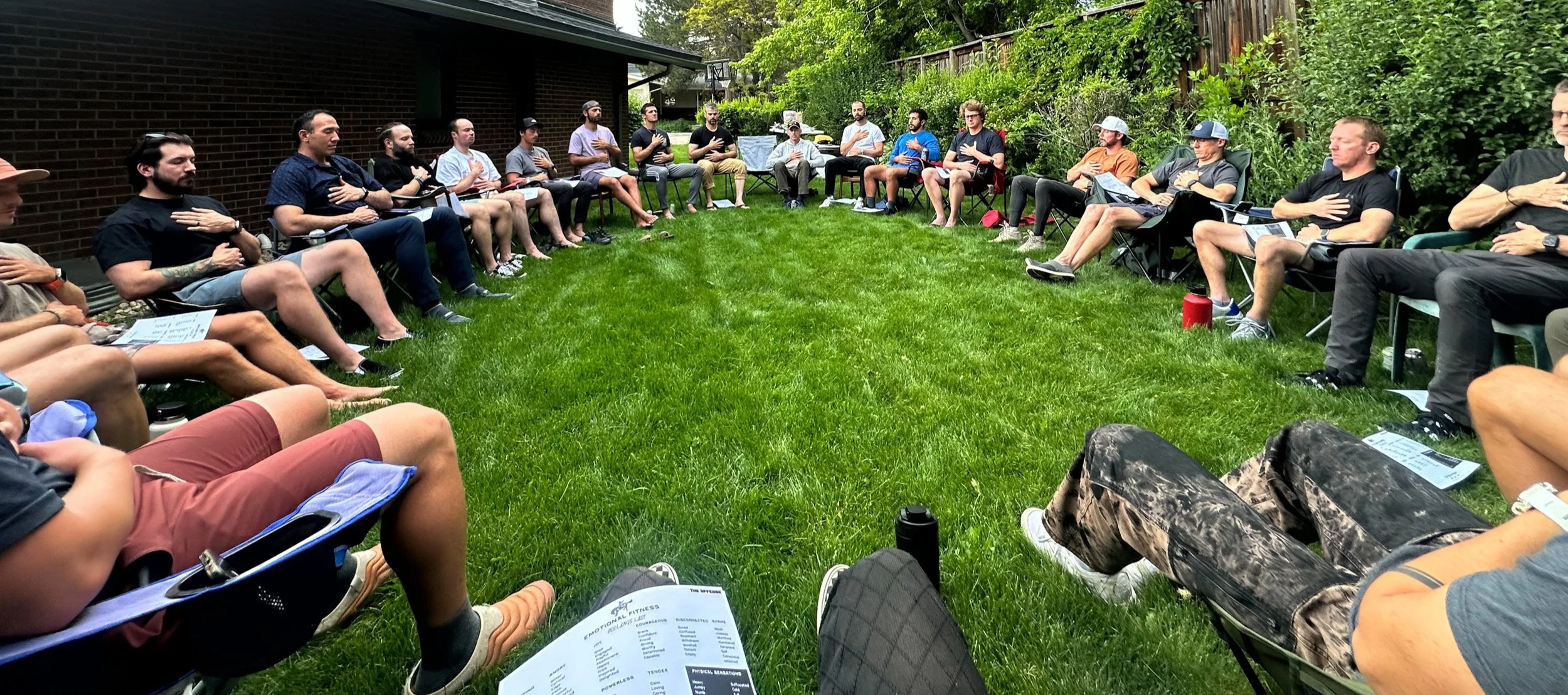
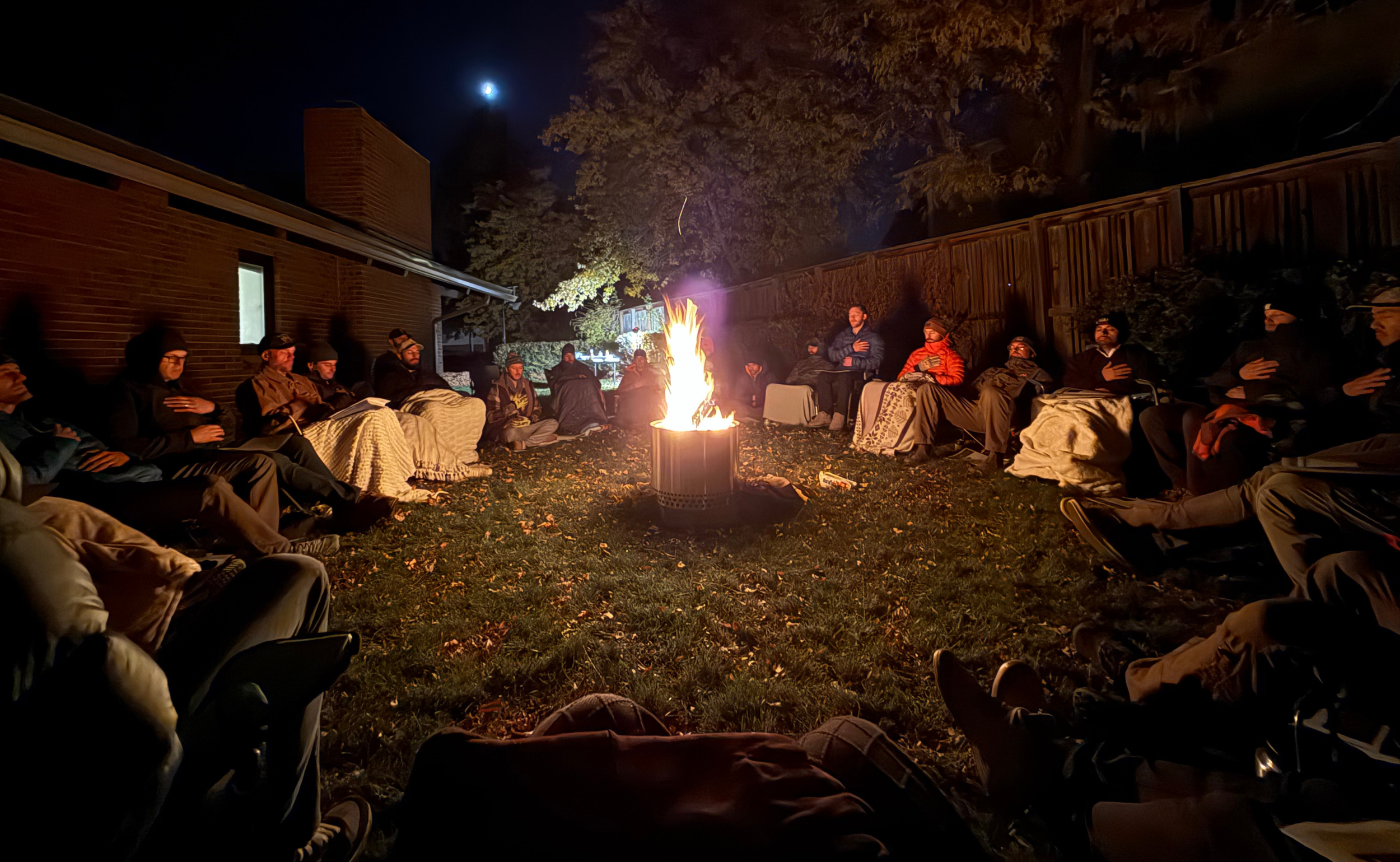
The men's group is a sober version of that conversation, held inside a structure that makes it possible on purpose rather than by accident. You eat together first, which matters more than it sounds, because shared food is one of the oldest ways humans signal trust and membership. Then you sit in a circle, and each man gets time to say whatever he wants, or to say nothing. No feedback, fixing, advising, one-upping. Just presence and being heard.
There is a version of this conversation that frames vulnerability as softness, as the surrender of the qualities that make a man effective in the world. I want to address that directly.
Emotional fitness is a skill. Like physical fitness, it can be trained, and like physical fitness, the training is uncomfortable, and the discomfort is the mechanism. A man who has never sat in a difficult feeling without immediately moving to fix or suppress it is not tougher than the man who has. He is less trained. He has avoided the reps. And the cost of avoiding them accumulates the same way the cost of avoiding the gym accumulates, slowly, invisibly, until one day the body, or the relationship, or the interior life, breaks down in a way that was entirely preventable.
What I have seen in fifteen years of coaching is that the men who are most afraid of this kind of conversation are often the ones who need it most, not because they are weak but because they have been strong in the wrong direction for a long time, carrying weight alone that was never meant to be carried that way.
And here is the part that does not get said enough: you are not just doing this for yourself. The men in your life who depend on you, your partner, your kids, your friends, your team, they feel the difference between a man who has done this work and one who has not. Emotional fitness is not a private project.
It is the foundation of every relationship you are responsible for, and the people you lead will tell you, if you ask them honestly, that they would rather have more of you than more of your output.
If you are coming to the group for the first time, you do not need to share anything you are not ready to share. You do not need to have a crisis or a revelation. You can come, eat, sit in the circle, and pass your turn, and that is a completely legitimate way to be there.

Many men who show up do not know anyone. Most of them leave having met someone they did not expect to meet. A few will tell you, months later, that it was one of the better decisions they made that year, not because something dramatic happened but because they found out that a room like this exists and that they are welcome in it.
Mark came back the second month. And the third. He has not solved the things he was carrying when he first walked in. But he is not carrying them alone anymore, and that turns out to make a larger difference than he expected.
The question worth sitting with is not whether you need this. Most men do, and the data is fairly unambiguous on that point. The question is whether you are willing to walk into a room where it is finally the right time, and find out what happens when you stop waiting for a better moment that was never going to come.
Mike
References
Holt-Lunstad, J., Smith, T. B., Baker, M., Harris, T., & Stephenson, D. (2015). Loneliness and social isolation as risk factors for mortality. Perspectives on Psychological Science.
Junger, S. (2016). Tribe: On Homecoming and Belonging. Twelve.
Putnam, R. D. (2000). Bowling Alone: The Collapse and Revival of American Community. Simon & Schuster.