How to Want Less: Why Chasing More Is Keeping You Stuck
A client of mine got the promotion he had been working toward for two years. He called me the day it happened and I expected him to be fired up, but the energy was flat. He said something I have heard more times than I can count: "I thought this would feel different." He told me he felt like he was pretty good at most things and pretty happy, but if he was being honest, he had been wondering what it would look like if he actually strived for more, and the promotion was supposed to be the answer to that question. Within a month, he was already talking about the next move, the next title, the next level, and when I pointed out that he had not even let this one land yet, he looked at me like I had said something in a language he did not speak. He was not celebrating. He was already chasing the next thing, because the thing he just got had not produced the feeling he was sure it would.
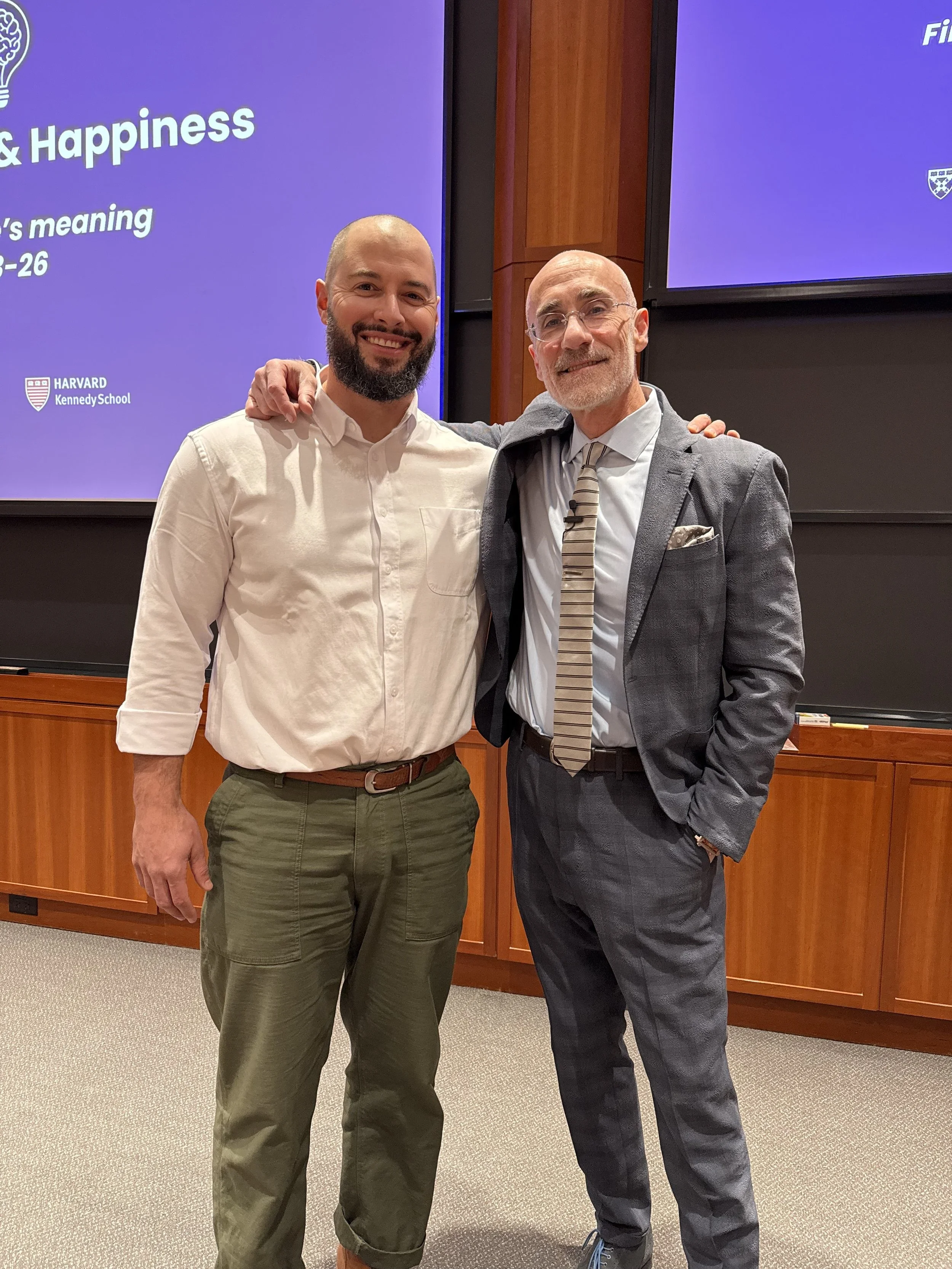
I sat in on Arthur Brooks's Leadership and Happiness class at Harvard Business School, and the thing that stuck with me was not the research itself but how many people in that room, some of the most accomplished people you could find, were nodding along like he was describing their life. Brooks has a line that changed how I think about this. The problem for most people is not that they do not have enough. The problem is that they want too much, and no amount of getting will fix a wanting problem. That idea sounds simple until you sit with it and realize how much of your life is organized around the assumption that the next achievement, the next milestone, the next version of success is going to be the one that finally makes things feel complete.
The research backs this up in a way that is hard to argue with. In 1971, Philip Brickman and Donald Campbell published a paper on what they called the hedonic treadmill, and the basic finding is this: when something good happens to you, whether it is a raise, a new house, a professional achievement, or a relationship milestone, your happiness increases for a period of time and then returns to roughly where it was before. The adaptation is so consistent that researchers have documented it across almost every domain of life. You get the thing you wanted, you feel good for a while, the baseline reasserts itself, and now you need the next thing. The treadmill keeps moving and you keep running, and the destination you are chasing keeps receding at exactly the pace you are approaching it. My client was on that treadmill and did not know it, and honestly, most of the people I work with are on it too, because each individual pursuit feels like it is going to be the one that finally sticks.
What makes the treadmill so dangerous is that it does not feel like a treadmill while you are on it.
It feels like ambition, and the culture rewards it, which makes it even harder to question.
Most people do not have a success problem. They have a definition problem.
Brooks draws a distinction that I have found genuinely useful, both for myself and for the people I work with. There is hedonic happiness, which is pleasure and positive feeling, and there is eudaimonic happiness, which is the sense of meaning, purpose, and growth that comes from living in alignment with your values.
The treadmill runs on hedonic happiness. You chase the spike, you get the spike, the spike fades, you chase the next one. Eudaimonic happiness works differently because it does not depend on arriving somewhere. It comes from the ongoing practice of investing in things that compound rather than fade: deep relationships, meaningful work, personal growth through chosen difficulty, a sense that your days are connected to something that matters beyond your own comfort.
The shift is not about wanting nothing. I have been on this treadmill myself. I love having goals, and I always will, but in my younger years, I struggled to actually feel the accomplishment after I hit one. I would finish and immediately reach for the next thing without giving myself any time to let it land, and it took me a long time to learn that there is a personal art to that, to knowing how to sit with what you just did before you start chasing what comes next. I am not arguing for some kind of monastic detachment from ambition, because I still sign up for things that scare me, and I do not plan on stopping. The shift is about getting honest with yourself about what you are actually chasing and whether it is what will make your life feel like yours.
In my experience, when people do this honestly, the list gets shorter. They want less, but what they want matters more. They stop chasing the next race because they are supposed to and start choosing the challenges that actually mean something to them. They stop saying yes to things that look impressive and start protecting the time and the relationships that are already in front of them.
Here is what I would ask you to try. Take fifteen minutes this week and write down the five things you are currently working toward. Next to each one, write why. Not the surface reason, the real one. If the honest answer to why is "because I think I'm supposed to" or "because I'll feel behind if I don't" or "because I am becoming more detached from what I actually need and this feels like the responsible thing to do," that is the treadmill talking. Cross it off. What is left on that list after you remove the obligation and the comparison is probably closer to what you actually need, and it is probably fewer things than you started with. That is not a loss.
That is the beginning of building a life that does not need the next thing to feel complete.
References:
Brickman, P. & Campbell, D. T. (1971). Hedonic relativism and planning the good society. In M. H. Appley (Ed.), Adaptation Level Theory: A Symposium. Academic Press.
Brooks, A. C. (2022). From Strength to Strength: Finding Success, Happiness, and Deep Purpose in the Second Half of Life. Portfolio/Penguin.