Strength Training is More Than the Weight on the Bar
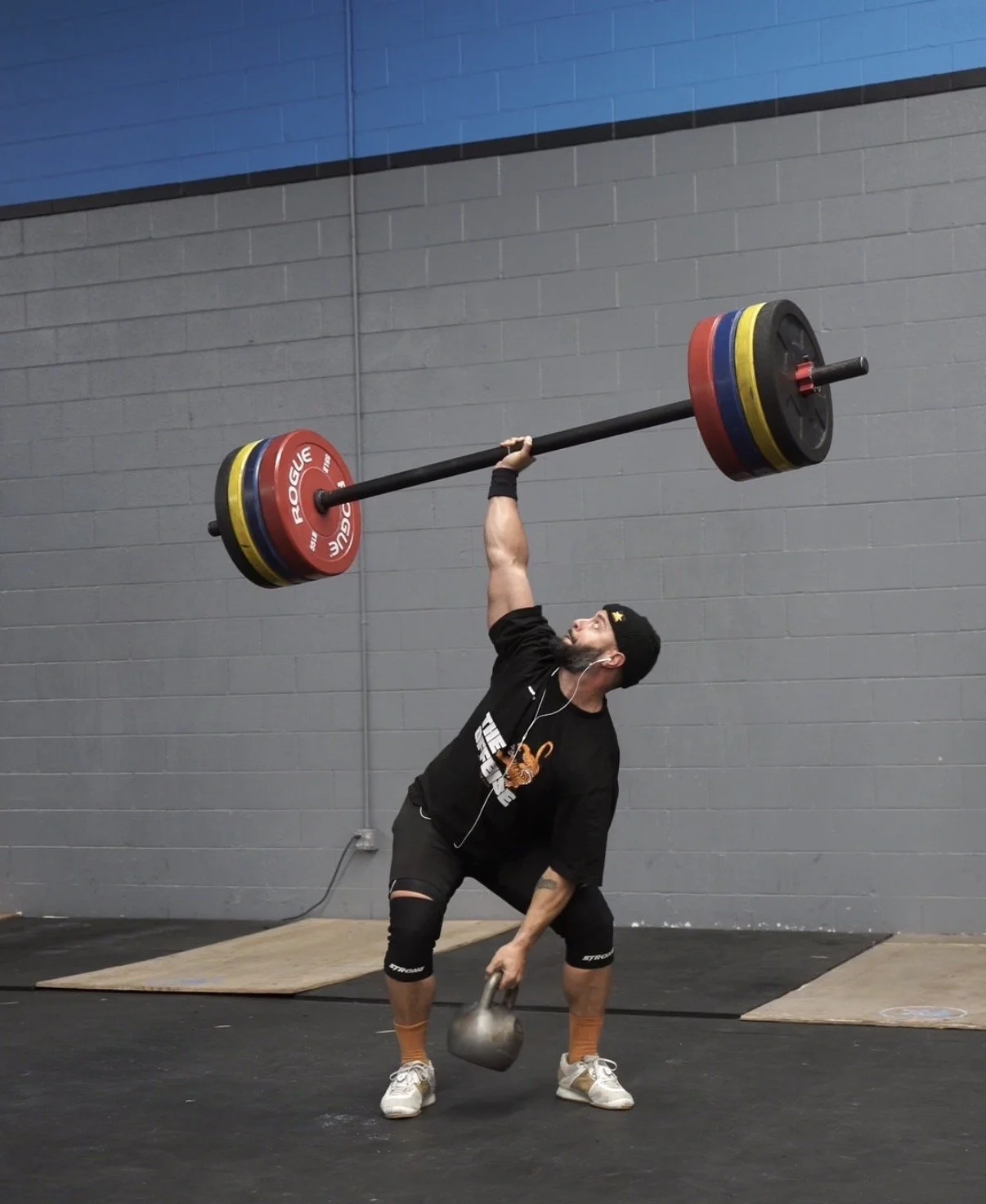
325 lb barbell and 75 lb Kettlebell (Two Hands Anyhow)
Earlier this year, I was in my garage working on a lift called the Two Hands Anyhow, and the first thing you notice is how unstable it is from the start. You are not easing into position the way you would with a back squat or a clean. The bar begins vertical, not horizontal, and you have to wedge yourself underneath it from the side, already slightly out of position, knowing that if you are off by a few inches, the whole thing can go wrong in a way that matters. From there, you rock down into the bottom of a squat, stand it up, drive it overhead from behind the neck, shift it to one hand, and then, while holding that position, bend down to pick up a second weight and press that overhead too. My best version of it is 331 pounds on the barbell and 75 pounds on the kettlebell, 406 pounds total, and at that point, it stops feeling like a normal lift and starts feeling more like a question you are answering with your body.
This lift has taught me something I did not know before, and it has very little to do with the weight itself. It is not just strength, nor is it just coordination. It is the experience of putting yourself in a position where your current story says something is not possible and then staying there long enough to find out if that story is actually true. That is the part I care about, because in my coaching work and in my own life, I keep running into the same pattern, which is that people are not stuck because they lack information. They are stuck because they are living inside a story that has not been challenged in a long time.
The two hands anyhow is one of the oldest movements in the history of organized lifting, and the lifts in its lineage have a story worth knowing. In the late nineteenth and early twentieth centuries, before commercial gyms and adjustable barbells, men who trained for strength were performers as much as athletes. Eugen Sandow, the figure on the Mr. Olympia trophy, sold out theaters across Europe and the United States. Arthur Saxon, called the Iron Master, wrote the foundational text on one-arm overhead lifting. They could not adjust the load on the bar, so they made the movements harder instead. Constraint became creativity. Then came bumper plates, squat racks, and machines for every joint angle. The old lifts became unnecessary, and in fitness, unnecessary usually means forgotten.
They are coming back now, and the people learning them are not nineteen-year-old strength athletes chasing novelty. They are thirty-five, forty-five and fifty-five-year-old lifters and endurance athletes who have already trained for decades. I see it in the rise of strongman gyms, the resurgence of kettlebell sport, the slow but real interest in hand balancing and odd-object strength training among people who are well past the age where most lifters are looking for something new. I do not coach people on these specific lifts. What I do is help people find their own version of the two hands anyhow, the puzzle in their own life that requires them to start over and be a beginner again, what the Zen tradition calls shoshin or beginner's mind, and that work has shown me something about why the lifts themselves are gaining traction.
Here is what I think is going on.
There is a kind of work that happens in the body that cannot happen in the mind alone, and the people doing it are stumbling into it without quite being able to explain why it matters. Some of them are learning circus lifts, others are racing Hyrox, and many are signing up for their first ultramarathon at twenty-five or forty-five. The specific practice matters less than what connects them, which is that they are choosing to put their body in a position to do something they did not really believe they could do. I sure as hell never thought I would be able to hold anything near 331 lbs over my head with one hand. The wellness industry has built a lot of good tools for changing the story you tell yourself about who you are. Therapy, journaling, coaching, meditation, cognitive reframing. These tools work and they matter, and I use many of them with my clients. But they all work through words, and words are only one of the places where the story of who we are gets stored.
The psychologist Dan McAdams has spent his career studying what he calls narrative identity, which is the idea that adults make sense of who they are by building a kind of running autobiography in their head, a story that organizes the past into meaning and points toward who they are becoming. McAdams' research shows that this story is not fixed, it can change. The events that change it most are the ones that the existing story cannot make sense of, and for most adults, those events come from outside and are not things we choose. A loss, a diagnosis, a divorce, a career rupture, a child, a death. The story bends around what life delivers. What is much rarer, and what I think we have not paid enough attention to, is the experience someone chooses on purpose because they want to do something the existing story says they cannot do, and then they go out and do it.
That is what circus lifts can do, and that is why I think the lifts are worth taking seriously, even though they look ridiculous and have no obvious utility outside themselves. The lifts are not an optimization hack. They are a small, controlled version of that chosen experience, where you go up against a previous version of yourself who thought certain movements were impossible, and you come out the other side as someone for whom they are not. That outcome lives in your body in a way that no thought reframe can match.
Albert Bandura, the Stanford psychologist, showed half a century ago that the most powerful source of belief in your own capability is what he called mastery experience, which is just the actual lived event of doing the thing. Reading about it does not get you there. Being told you can do it does not get you there. No matter how much you read about what a cake tastes like the one way to know is to take a bite. A 2025 paper by Pninit Russo-Netzer and Yael Atad on embodied meaning-making further develops this. They argue that we not only build meaning through the stories we tell ourselves but we also build it through the things we do with our bodies. When the body does something the mind did not believe it could do, the story we tell about ourselves has to change and we grow as people.
This is what is going on under the surface, and it is part of why the people I work with who are taking on real puzzles in their own lives, physical and otherwise, are quietly telling me that something has changed in how they show up to the rest of their world. They are not lifting more in their day jobs. They are not stronger in any way that matters at the office. But the story they tell themselves has changed, and that change comes with them everywhere else.
I worked with a man last year who came to me describing his life with a word I have been hearing more and more in my coaching practice, which was hollow. He was successful by every external measure, married, well-paid, respected in his work, and he could not point to anything that was actually wrong. He just felt numb most days, like he was watching his own life from a slight distance. We talked for a while about the usual things: his schedule, his sleep, his relationships, his work, and none of it was the problem. The problem was that nothing in his life had asked anything difficult of him in a long time, and the absence of difficulty had quietly removed the evidence he needed to feel like himself. So we picked something. He had never run more than a few miles in his life and had always thought he hated running. After digging into it, what we found was that he had never actually understood how to learn to run effectively and efficiently. We talked through heart rate zones, training time, recovery, and the basics of how the system was supposed to work, and the whole thing started to demystify for him. Soon he signed up for a fifty-kilometer trail race nine months out, which was the kind of decision that made him laugh nervously when he said it out loud. He trained through the winter and through the spring, and he finished the race.
When we talked afterward, he did not want to talk about the race. He wanted to talk about who he had become in the process of training for it. The numbness was gone, not because the race fixed his life, but because the training had given him back the kind of evidence about himself that no amount of talking could produce. The puzzle did the work. He was quickly looking for another race to sign up for because he liked the person it challenged him to become.
You could ask, reasonably, why circus lifts in particular, and not just more weight on a regular lift, and that question matters because the answer is in the puzzle quality of the lifts themselves. A back squat is a known quantity. You have done it ten thousand times, and adding weight to it is real work, but it does not require you to be bad at something again. The two hands anyhow does. The Steinborn squat does. The bent press, the side press, the get-up, the one-arm clean, a handstand. These have a coordination and a balance demand that no amount of previous strength training can shortcut. You have to start over. You have to be a beginner in a body that already knows how to lift.
Most adults stop doing this in their teens or twenties. They specialize, they get good at what they are good at, and they avoid the rest. By forty, the average high-functioning adult has not been a beginner at anything in fifteen years. That is a quiet problem, and I think it is part of what people are reaching for without knowing it when they take up something genuinely new and difficult.
In most of the popular wellness writing, the body shows up as either something to optimize or something to manage. It almost never shows up as one of the main places where adults actually change who they are, and the research suggests that is a real gap.
This is the thesis of a longer project I am working on, rooted in my positive psychology studies at Penn, called Meaning in Motion. The argument is that the deepest changes in adult life often happen through the body, not despite it. Anything that asks you to take on a version of yourself that thought something was impossible, and to come out the other side as someone different, is doing real psychological work.
If your training feels stale, if your story has flattened, if you have been competent for too long, the answer is probably not another protocol or another supplement or another optimization. The answer may lie in a hard physical thing you do not yet know how to do, a willingness to be bad at it for a while, and patience for the slow work of figuring it out. The body is where new identities get proven, not where they get described.
Where in your life have you stopped being a beginner?
Mike
References:
Bandura, A. (1977). Self-efficacy: Toward a unifying theory of behavioral change. Psychological Review. McAdams, D.P. (2001). The psychology of life stories. Review of General Psychology.
Csikszentmihalyi, M. (1990). Flow: The Psychology of Optimal Experience. Harper & Row.
Dweck, C. (2006). Mindset: The New Psychology of Success. Random House.
Russo-Netzer, P. & Atad, Y. (2025). Embodied meaning-making and the somatic foundations of well-being.